
Real sales first. Optional estimates second.
Radish Price Guide is built so the foundation remains clear: the core values shown are based on real recorded final eBay sales. Optional tools like personal estimates, peer-to-peer sale submissions, and comp-based estimates are secondary layers designed to help collectors interpret the market — never replace it.
1) Real eBay sales are the anchor
When you search cards, the baseline pricing reflects actual recorded final eBay sales. That is the primary market data layer.
2) Private estimates stay private
A collector can assign a value to a card in their own collection, but that estimate is only visible to that user in their own view.
3) Optional tools add context
Peer-to-peer sales and comp estimates are there for additional insight, especially for rare cards, but users must choose to consider them.
What Radish Price Guide actually does
There has been confusion around how values appear in the system. Here is the clean version of how the platform works today and where it is headed.
Search values are built from real final eBay sales
The key point is simple: Radish Price Guide does not let random public user inputs overwrite the core market data shown as actual sales.
- Real recorded final eBay sales are the main data source.
- Those real sales remain the first thing collectors should look at.
- Optional valuation layers are there only to provide additional context.
A user’s personal estimate does not become public market data
Yes, users can assign a value to a card in their own collection. But that value is a personal estimate, not a public comp, and not something that other users see as the card’s official market value.
- Most useful when a card has no recent sale.
- Useful when a collector disagrees with an old or stale sale.
- Only visible inside that collector’s own collection experience.
Your estimate is for you
Personal estimated values are meant to help collectors organize their own collection view — not to create fake public pricing.

Estimated card value
This allows a collector to place an estimated number on a card in their own collection when they want something listed, especially if there are no sales or if they believe a stale sale no longer reflects the market.
That estimate is private. It is not a public sale record and it is not used as a replacement for verified eBay sales data.
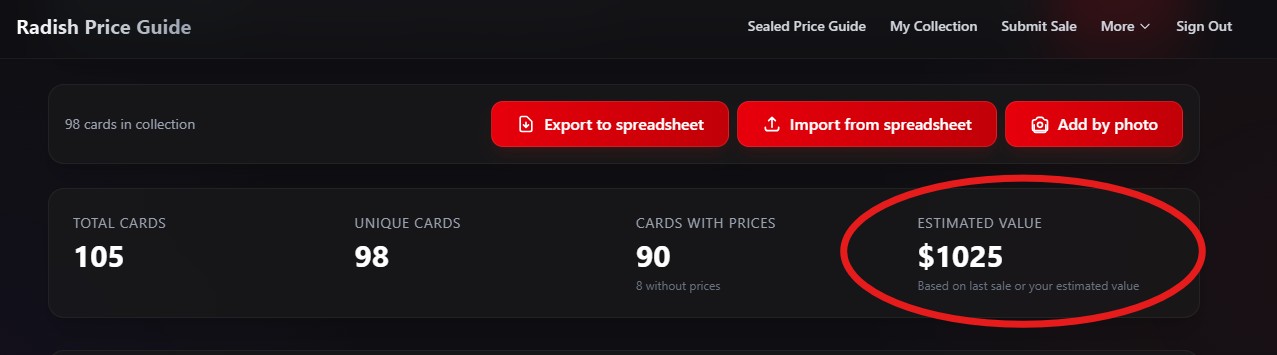
Estimated collection value
This is the place where a collector may see those private estimate values affect the total estimated worth of their own collection.
That is intentional. It helps users manage their own inventory and track what they think their collection is worth, without changing the public-facing record of real sale history.
Peer-to-peer sales are an optional secondary layer
Radish Price Guide includes a public Submit Sale feature because many of the most important BoBA cards may never sell publicly on eBay more than once — or ever.

Why this exists
For 1/1s, Hexs, Glows, and other very rare cards, waiting only for final eBay sales can leave collectors with almost no usable market context.
- Some cards may have only one sale in our lifetime.
- Many important transactions may happen privately, not on eBay.
- This feature helps capture real market information that would otherwise disappear.
Submission → review → optional visibility
Submitted private sales are not meant to go straight live as unreviewed pricing. The intended process is:
Submit
A member submits a private sale for review through the platform.
Review
The sale is reviewed to verify legitimacy before being included as market context.
Optional Toggle
Users can choose whether to turn peer-to-peer sales on when evaluating a card.
The default remains real verified final eBay sale prices. At no point will a collector be forced to use peer-to-peer sales information.
The order matters: real eBay sold data first, then optional layers like peer-to-peer sales and comp estimates for collectors who want more context.
In other words, Radish Price Guide is not replacing real market sales with guesses. It is preserving the real sales record while also offering additional tools for hard-to-price cards.The Radish “Zillow-style” estimate for cards with no sales
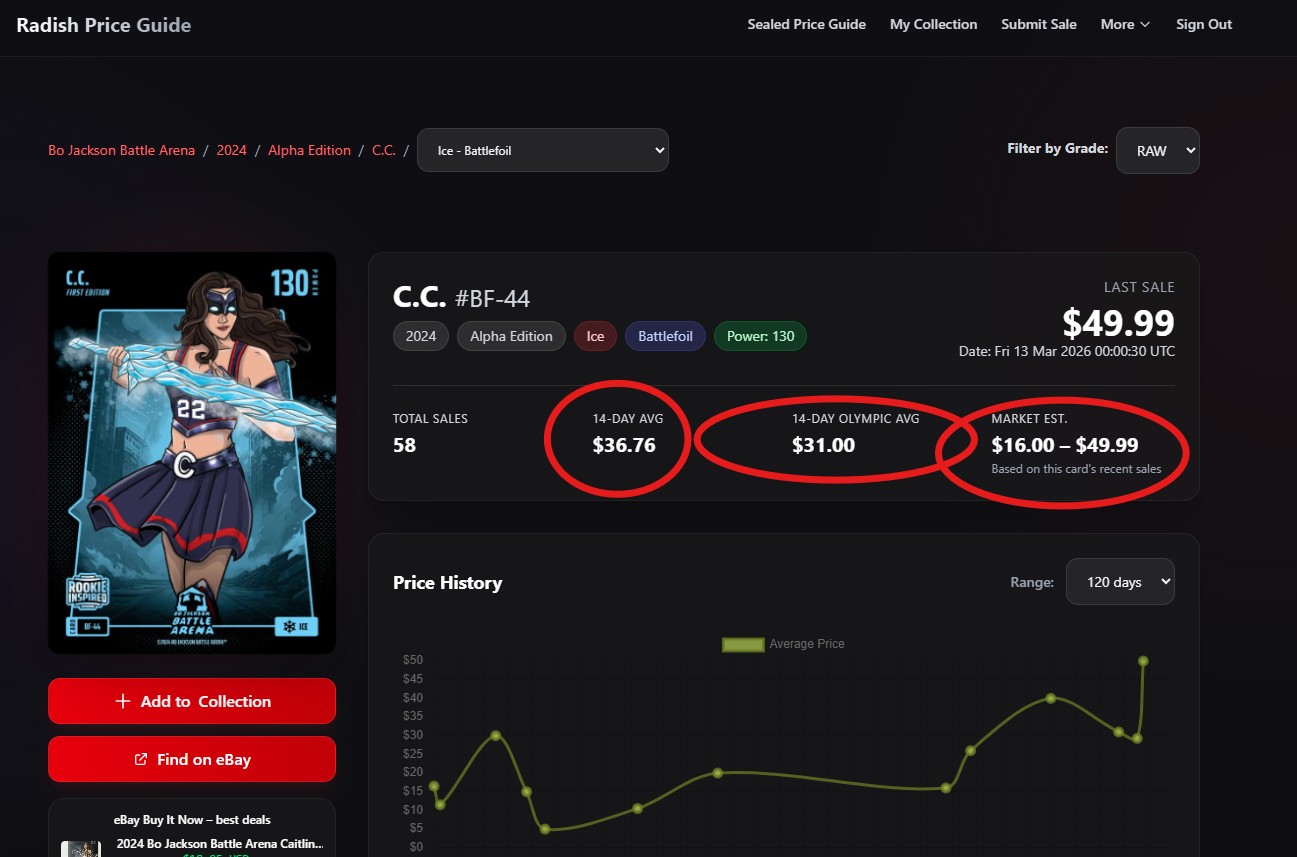
For cards with limited or no direct sales, Radish Price Guide can provide a comp-based estimate range. This is not presented as a replacement for real sales — it is a supporting estimate built from the closest available comps.
What you may see
In examples like C.C., the platform can show multiple ways of understanding value:
- Recorded actual sales
- A comp-based estimate range
- An Olympic average approach that excludes the highest and lowest sale to reduce outlier distortion
This gives users more than one lens for interpretation, while still preserving real sales as the foundation.
How the estimate currently finds comparable cards
The system looks for up to 5 closest comps and uses a priority order to determine which sales are the most relevant.
- First priority: same hero / weapon / power / set
- Second priority: same weapon / power / parallel / set
- Third priority: same weapon / power / set
If it cannot find 5 comps in the last 30 days, it expands the search to the last 60 days.
Additional logic includes treating Fire and Ice as related when appropriate, while certain categories such as Paper, BF, ABF, and Autos stay within their own parallel family for cleaner comps.
A smart future refinement may be to ensure at least 1–2 comps from the same parallel are included whenever possible.
The simple collector takeaway
This is the easiest way to understand the platform without getting lost in the details.
Start with real sales
The first thing to trust and review is the actual recorded final eBay sale history tied to the card.
Use estimates as context
Comp ranges and personal estimates are there to help interpret the market when direct sales are sparse or stale.
Choose whether to include private sales
Peer-to-peer sales are not forced into your decision-making. They are an optional toggle for collectors who want the extra data.